
Key assessments remain connected to observable signals and source material.
Atlas Protocol · Intelligence Core · Public Methodology
Intelligence Methodology
The analytical discipline behind the Atlas Intelligence Core. Atlas Protocol structures observation, verification, multi-perspective analysis, systemic interpretation and strategic synthesis so that complex developments can be understood without confusing evidence, inference and assumption.
Observe broadly. Analyse independently. Challenge assumptions. Revise when reality demands it.
Methodological boundary
Method before model
Atlas Protocol does not begin by defending a preferred explanation of the world. It begins with observation, evidence and competing interpretations.
Models, scenarios and institutional hypotheses are analytical tools. They may organise complexity, expose assumptions and test possible consequences — but they remain subordinate to evidence.
“A model earns value by improving understanding — not by surviving criticism.”
Analytical discipline
Separate what we see from what we think it means.
Observation identifies what changed. Verification tests the signal. Interpretation examines meaning and interaction. Assessment states what the evidence currently supports.
Confidence, uncertainty, contradictions and alternative explanations remain part of the analytical record rather than being hidden behind a single narrative.
Explore Atlas Thinking →From Observation to Decision Support
Atlas analysis follows a revisable process: signals are verified, interpreted and communicated, then reassessed when fresh evidence arrives. The stages can overlap and are not a fully automated production chain.
Feedback and correction apply throughout the cycle. For consequential findings, human review remains necessary before publication or decision support.
A Systems Perspective
Systemic change rarely emerges from a single cause. Atlas Protocol therefore reads geopolitical, economic, technological, environmental, institutional and human developments as interacting systems rather than isolated events.
Core Analytical Principles
These principles govern how Atlas Protocol turns observation into structured intelligence.
What Can Change — And What Should Not
Atlas distinguishes its human-centred purpose from the analytical structures used to pursue it. This prevents institutional identity from becoming dependent on any single model or conclusion.
Stable Institutional Layer
MissionMake global complexity understandable so people and organisations can make better strategic decisions.
PurposeUnderstand earlier. Anticipate better. Decide more wisely.
Human-Centred PrinciplesThe purpose remains anchored in dignity, responsibility, prevention, fairness and connected-world thinking.
Revisable Analytical Layer
Methods & WorkflowsAnalytical procedures evolve as evidence, technology and capability improve.
Models & HypothesesFrameworks remain open to challenge, comparison, revision or replacement.
AssessmentsConclusions remain provisional and must change when evidence changes.
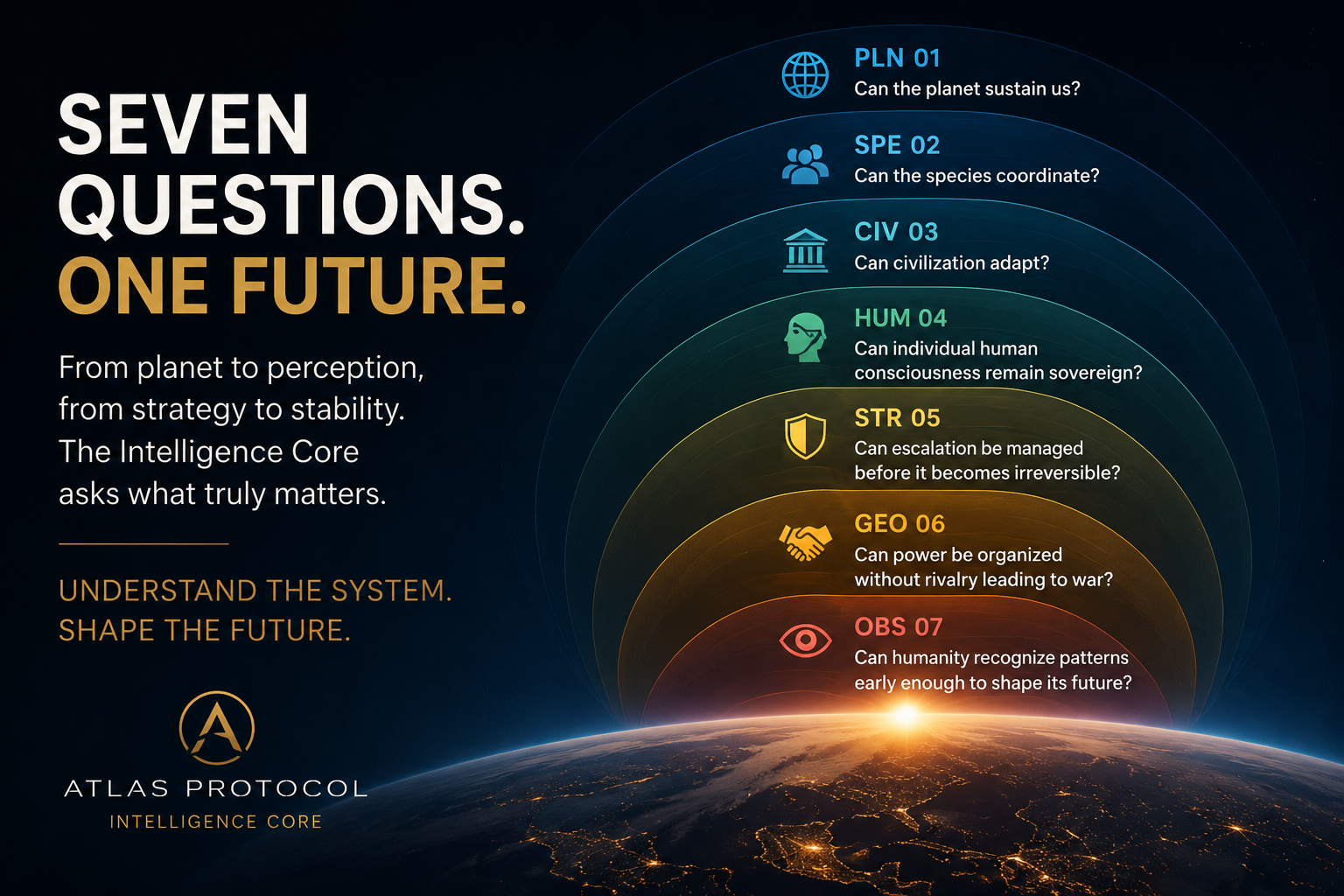
The Seven Analytical Layers
The Intelligence Core connects six analytical domains with OBS 07, the observational layer that supports verification, pattern recognition and responsible strategic synthesis.
Atlas Protocol · Public Methodology Reference
Atlas Intelligence Methodology — System Master File
Explore the institutional reference behind the seven-layer framework, evidence discipline, analytical cycle, uncertainty management and methodological governance.
Public edition · v1.1 · 22 October 2026 · PDF
Method inside the Atlas System
The methodology is not a separate product. It is the analytical discipline connecting observation, understanding, anticipation and decision support across Atlas Protocol.
Intelligence Architecture
Observe · Atlas LIVEGeospatial observations, with coverage and freshness depending on each verified data feed.
Understand · Intelligence CoreSeven analytical layers, with OBS 07 integrating evidence from the six upstream layers.
Anticipate · Strategic IntelligenceDated assessments and conditional scenarios, with stated uncertainty.
Decide · Atlas Protocol InstituteDecision support, leadership advisory and specialist expertise.
Test & Challenge
Atlas ThinkingThe reasoning discipline behind the analytical system.
Models & FrameworksTestable tools for structuring assumptions and possible responses.
GSSCMA structured monitoring framework; indicator validity and current release status require separate verification.
Conflict AnalysisApplication of the method to complex geopolitical tensions.
What methodological discipline should produce
These are required publication standards and review goals, not certification that every dashboard or feed already passes every gate.
Inference and hypothesis are distinguished from direct observation.
Confidence, limitations and unresolved contradictions remain visible.
New evidence can alter the interpretation without threatening the integrity of the method.
Evidence, Confidence & Operational Boundaries
The minimum discipline expected of a public Atlas assessment, from initial observation through correction.
Identify the source, event time (UTC), geographic scope, data quality and what is directly established. A map marker or copied report is not independent verification.
Explain the analytical hypothesis, supporting and contradictory evidence, source independence, competing explanations and confidence rationale.
Specify conditional scenarios, observable triggers, decision horizon and falsifiers. A numerical probability is not justified without a documented calibrated model.
Record the latest verification time, next review trigger and correction history. Unverified, developing or degraded sources remain visibly labeled as such.
Atlas Live is the observational interface; OBS 07 supplies the verification and synthesis doctrine. Proposed integrations and monitoring functions should never be presented as fully operational without evidence of deployment and validation.
Why this page exists
Atlas Protocol separates observation, interpretation, models and conclusions so that analytical confidence does not depend on hiding uncertainty. The objective is not to make intelligence look certain, but to make the reasoning behind it more disciplined, challengeable and useful.
Intelligence is not certainty.
It is the disciplined pursuit of better understanding. Atlas Protocol does not seek to eliminate uncertainty. It seeks to make uncertainty visible, assumptions explicit and strategic decisions better informed. Methods may evolve, models may be challenged and conclusions may be reversed when evidence requires it.
Atlas ProtocolPeople Before Power.

Understanding complexity. Supporting decisions. Putting people first.