
NATO — Collective Security
A transatlantic alliance built around collective defence is adapting to a more contested security environment. Its central test is whether political solidarity can be translated into credible deterrence, industrial readiness and societal resilience.
Institutional assessment · 18 October 2026

Collective defence through political consensus
NATO is an alliance of 32 sovereign member states from Europe and North America. Its decisions are taken by consensus. The North Atlantic Council provides the principal political forum; military commands and national forces support implementation.
Article 5 of the North Atlantic Treaty establishes an obligation to assist an Ally that has suffered an armed attack. The form of assistance is determined by each Ally and does not automatically require an identical military response from every member.
From The Hague commitments to the Ankara summit
At The Hague in June 2025, Allies agreed to aim for annual defence and defence-related security investment equivalent to 5% of GDP by 2035, comprising at least 3.5% for core defence requirements and up to 1.5% for wider security and resilience. These are future commitments, not proof that every Ally has already reached the targets.
At the NATO summit in Ankara on 7–8 July 2026, Allies reaffirmed Article 5, highlighted increased European and Canadian investment, and announced new procurement and industrial cooperation initiatives. Commitments and announcements must be distinguished from capabilities already delivered.
Atlas distinction: Political declarations, financial commitments, contracted procurement and deployable capabilities are different stages of collective security.
Six pressures shaping NATO’s effectiveness
Article 5 and deterrence
Deterrence depends on political resolve, interoperable forces and an adversary’s assessment of Allied readiness.
Forces, logistics and stockpiles
Military mobility, ammunition, air defence and sustainment determine how quickly commitments can become operational.
European and Canadian capacity
Greater non-US capabilities can strengthen the alliance while changing its internal balance of responsibility.
Production and innovation
Defence manufacturing, procurement coordination and supply-chain resilience constrain the pace of rearmament.
Cyber, space and hybrid threats
Attacks on networks, satellites and infrastructure complicate attribution, proportionality and collective response.
Civil preparedness
Energy, transport, communications and essential services are part of credible collective defence.
An alliance, not a supranational government
Consensus and consultation
Each Ally retains sovereignty; consensus creates legitimacy but can complicate speed and coordination.
Complementarity and overlap
NATO and the EU have distinct mandates; European defence investment can support both without making them interchangeable.
Support and security consequences
NATO Allies support Ukraine in different ways. Ukraine is not a NATO member and is not covered by Article 5.
Strategic capability concentration
American capabilities remain central in areas including nuclear deterrence, intelligence, logistics and high-end operations.
Cooperation beyond membership
Partnerships support dialogue and interoperability but do not confer NATO membership or Article 5 protection.
A contested security environment
Allied documents identify the long-term threat from Russia and the persistent threat of terrorism, alongside wider security risks.
Institutional perspective
A second institutional image is included below to complement the opening visual.
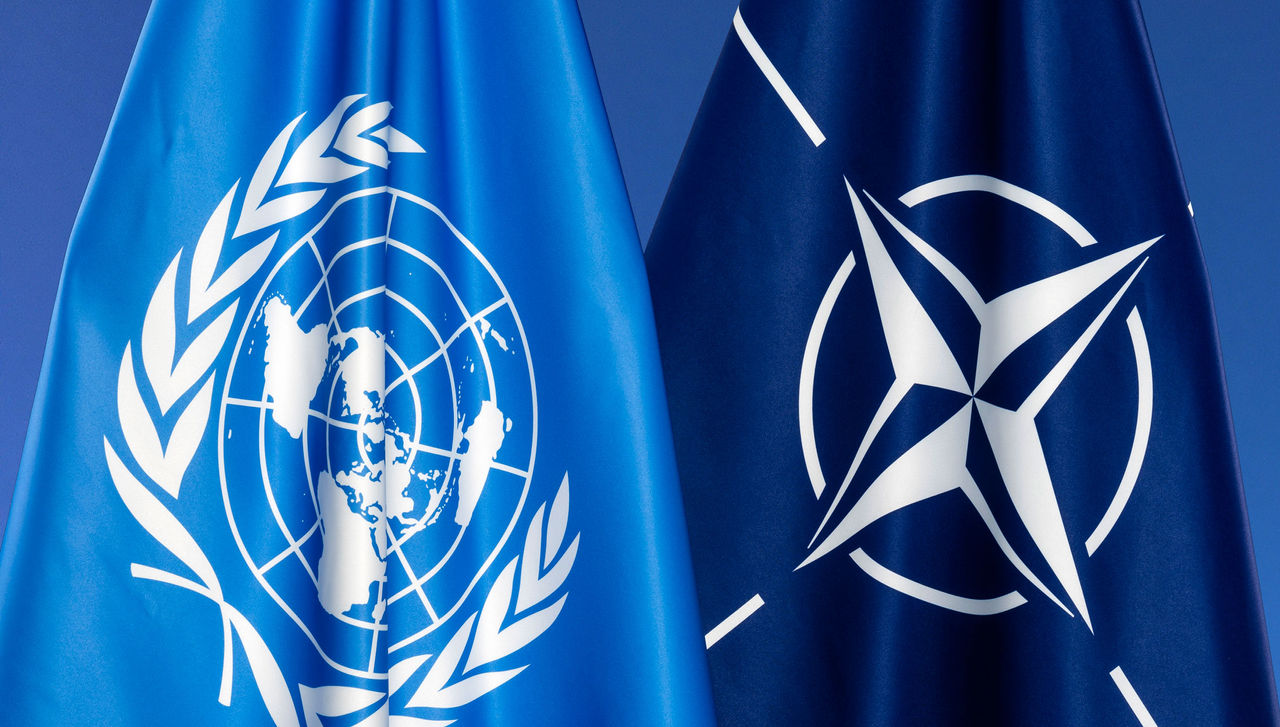
Deterrence has costs and governance limits
The alliance faces trade-offs between speed and consensus, national sovereignty and common planning, deterrence and escalation control, and defence expenditure and wider public needs. The 5% investment commitment raises questions about fiscal sustainability, procurement efficiency and measurable capability gains.
Article 5 is legally significant but not a mechanical guarantee of a uniform military action. NATO also remains geographically and institutionally distinct from the United Nations system.
Collective security is a test of institutional delivery
NATO demonstrates that institutional power rests not only on treaties, but on the ability to align political decisions, material capabilities and public resilience. The central 2026 question is whether investment commitments produce verifiable readiness without undermining democratic accountability or strategic stability.
Atlas assessment: An alliance is credible when its decisions can be implemented, its commitments can be measured and its security choices protect the people they are intended to defend.
Collective defence within international law
NATO’s Article 5 operates within the right of individual and collective self-defence recognised by Article 51 of the UN Charter. Atlas Protocol evaluates collective security through the protection of civilians, prevention of escalation, resilience of essential services and the accountability of decisions taken under pressure.
Official NATO documentation
Assessment cutoff: 18 October 2026. Official NATO positions are attributed to NATO; Atlas assessments are independent analytical judgments.

Understanding complexity. Supporting decisions. Putting people first.