
What happens when multipolarity begins to organise itself?
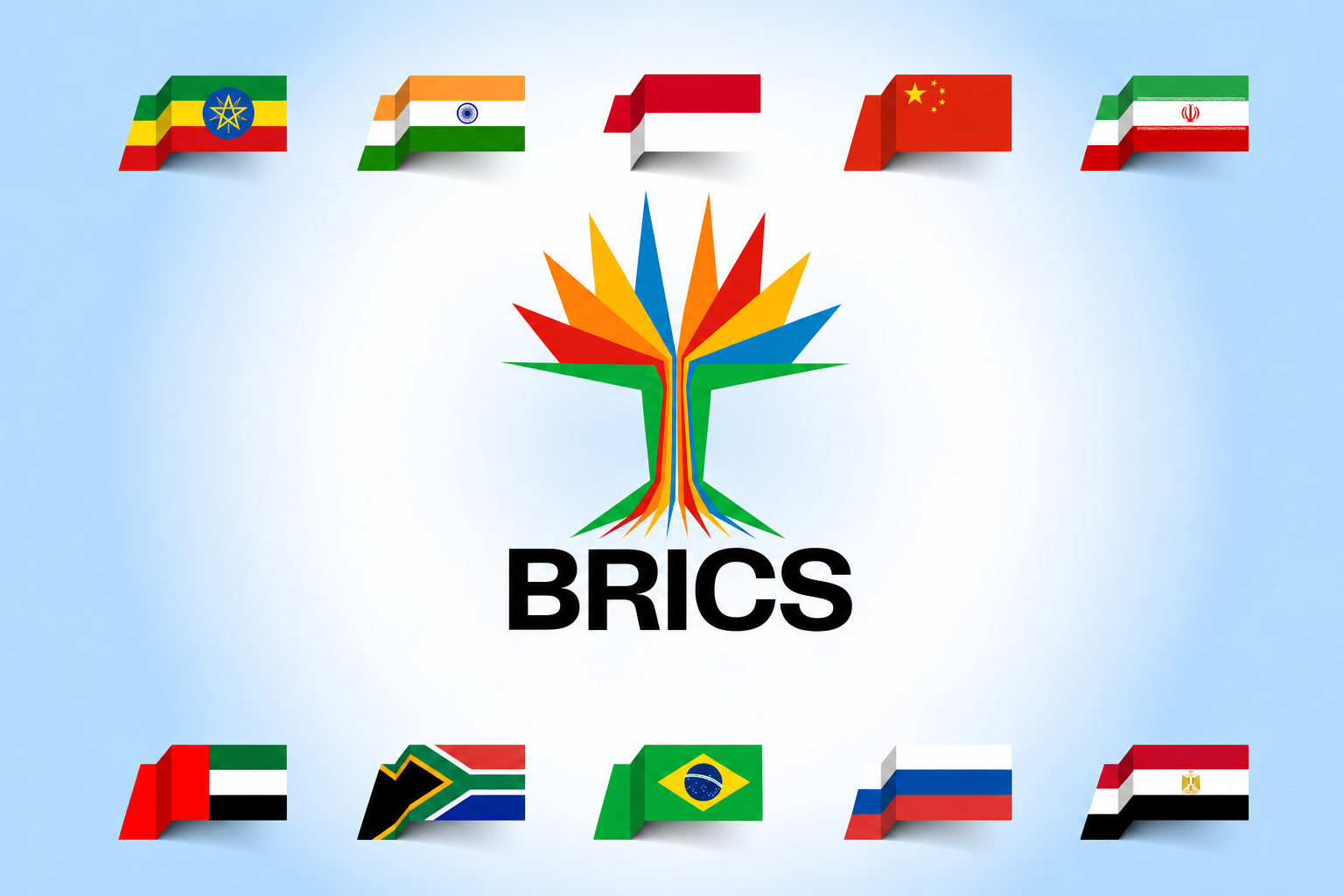
BRICS · Coalition-building in an emerging multipolar order
From an economic grouping to a wider platform for global governance.
BRICS began as cooperation among Brazil, Russia, India, China and later South Africa. Expansion has changed its scale and political diversity. The group now brings together eleven member states and a growing partner-country framework while maintaining consensus as the basis for decision-making.
For Atlas, the central question is not whether BRICS will replace the existing international order. It is whether a larger and more diverse coalition can convert growing multipolar weight into coherent institutional influence.
Three forces are shaping the next phase of BRICS
Expansion
BRICS has widened beyond its original five-country configuration. New members and partner countries extend its geographic reach across Asia, Africa, the Middle East, Latin America and Eurasia.
Global Governance Reform
BRICS increasingly coordinates positions around reform of international institutions, including greater representation for emerging and developing economies in global political and financial governance.
South–South Cooperation
Economic development, finance, trade, technology, climate, health and infrastructure provide practical areas through which political alignment can become sustained cooperation.
Eleven members — and a wider circle of partner countries
The expanded BRICS brings together Brazil, China, Egypt, Ethiopia, India, Indonesia, Iran, Russia, Saudi Arabia, South Africa and the United Arab Emirates. Alongside the members, a partner-country category creates a wider layer of participation around the group.
Representation is moving to the centre of the debate.
BRICS leaders have repeatedly called for international institutions to better reflect changes in the global distribution of economic and political weight. The agenda includes reform of the United Nations and its Security Council as well as reform of the Bretton Woods institutions.
The underlying argument is structural: institutions created under earlier distributions of power must remain legitimate and effective in a world where emerging and developing economies carry greater demographic, economic and geopolitical weight.
BRICS is simultaneously challenging and using the existing system.
Calls for reform do not necessarily imply rejection of multilateral institutions. Much of the BRICS agenda seeks greater influence and representation inside existing structures while also developing additional mechanisms for cooperation among its own members.
Multipolarity is becoming economic, technological and institutional.
BRICS cooperation increasingly extends beyond diplomatic coordination. Finance, trade, artificial intelligence, climate policy, health, energy and development all form part of the group’s expanding agenda. This creates a wider institutional laboratory in which alternative patterns of cooperation can develop without requiring the members to share identical political systems or strategic interests.
Six questions behind multipolarity in formation
Can global institutions adjust to the redistribution of power?
BRICS pressure for greater representation tests whether established institutions can evolve as demographic, economic and geopolitical weight shifts beyond their original post-war configuration.
Can a highly diverse Global South develop sustained collective influence?
The Global South is not a single geopolitical actor. BRICS tests whether countries with very different interests can nevertheless build durable cooperation around shared institutional objectives.
Does expansion strengthen BRICS — or make consensus harder?
Greater membership increases reach and weight, but also increases strategic diversity. The ability to preserve consensus while expanding may become one of the defining institutional tests for BRICS.
Will cooperation produce stronger permanent institutions?
Atlas follows whether BRICS remains primarily a coordination platform or gradually develops deeper institutional mechanisms capable of sustained implementation.
How far will financial diversification develop?
Reform of international financial governance, development finance and greater financial autonomy provide a practical test of how multipolarity translates into economic architecture.
Can multipolarity produce cooperation rather than fragmentation?
More centres of power do not automatically create a more stable international system. The deeper question is whether multipolar structures can generate mechanisms for coordination, responsibility and conflict management.
Different actors confronting the same structural transition
The European Union and BRICS approach the emerging international order from very different historical and institutional positions. The EU seeks to preserve rules-based cooperation while adapting multilateral institutions to a more contested environment. BRICS seeks greater representation and influence for emerging and developing economies while expanding cooperation across the Global South.
Multilateralism in transition
How can an established regional actor preserve cooperation and international law while adapting to a more multipolar distribution of power?
Multipolarity in formation
How can emerging powers translate greater global weight into representation, institutional influence and durable mechanisms for cooperation?
Atlas does not ask which side will define the next international order. It asks how different centres of power are responding to the same transformation — and where their interests converge, diverge or create new institutional possibilities.
Institutional pressure viewed from three different directions
BRICS, UN80 and UN v7 operate at different levels of the global governance debate. BRICS increases pressure for representation and reform from a changing distribution of global power. UN80 examines how the existing United Nations system can adapt from within. UN v7 asks whether deeper assumptions about representation, veto power and decision architecture should themselves be reconsidered.
Pressure from changing power
How should global institutions respond when emerging and developing economies demand greater representation and influence?
Reform from within
How far can the United Nations improve effectiveness, coherence and adaptability while remaining inside its established institutional architecture?
Institutional redesign
What becomes possible when representation, veto power and decision architecture are treated as design questions rather than fixed constraints?
Observe the system
Atlas compares these processes without treating any one of them as confirmation of its own model. Convergence and contradiction are both intelligence.
Primary source documents and verification
Atlas Protocol distinguishes institutional statements from independent assessment. The following primary-source document categories underpin the analysis. External document links are temporarily withheld pending verification of a stable official publication address.
BRICS Leaders’ Declarations
Summit declarations setting out collective positions and priorities.
Presidency Communiqués
Official statements and meeting outcomes issued under rotating presidencies.
Membership & Partner Announcements
Official decisions concerning membership, participation and partner status.
Development & Financial Cooperation
Primary materials concerning BRICS financial and development initiatives.
Observe multipolarity before defining it.
BRICS provides a live test of whether a more distributed international system can develop new forms of representation and cooperation without simply reproducing the structures it seeks to reform. Atlas follows that process as evidence — not as a predetermined outcome.

Understanding complexity. Supporting decisions. Putting people first.