
ASEAN — Regional Centrality
Southeast Asia's regional institution seeks to remain a convening centre for diplomacy, security dialogue and economic cooperation in an increasingly contested Indo-Pacific.
Institutional assessment · 18 October 2026
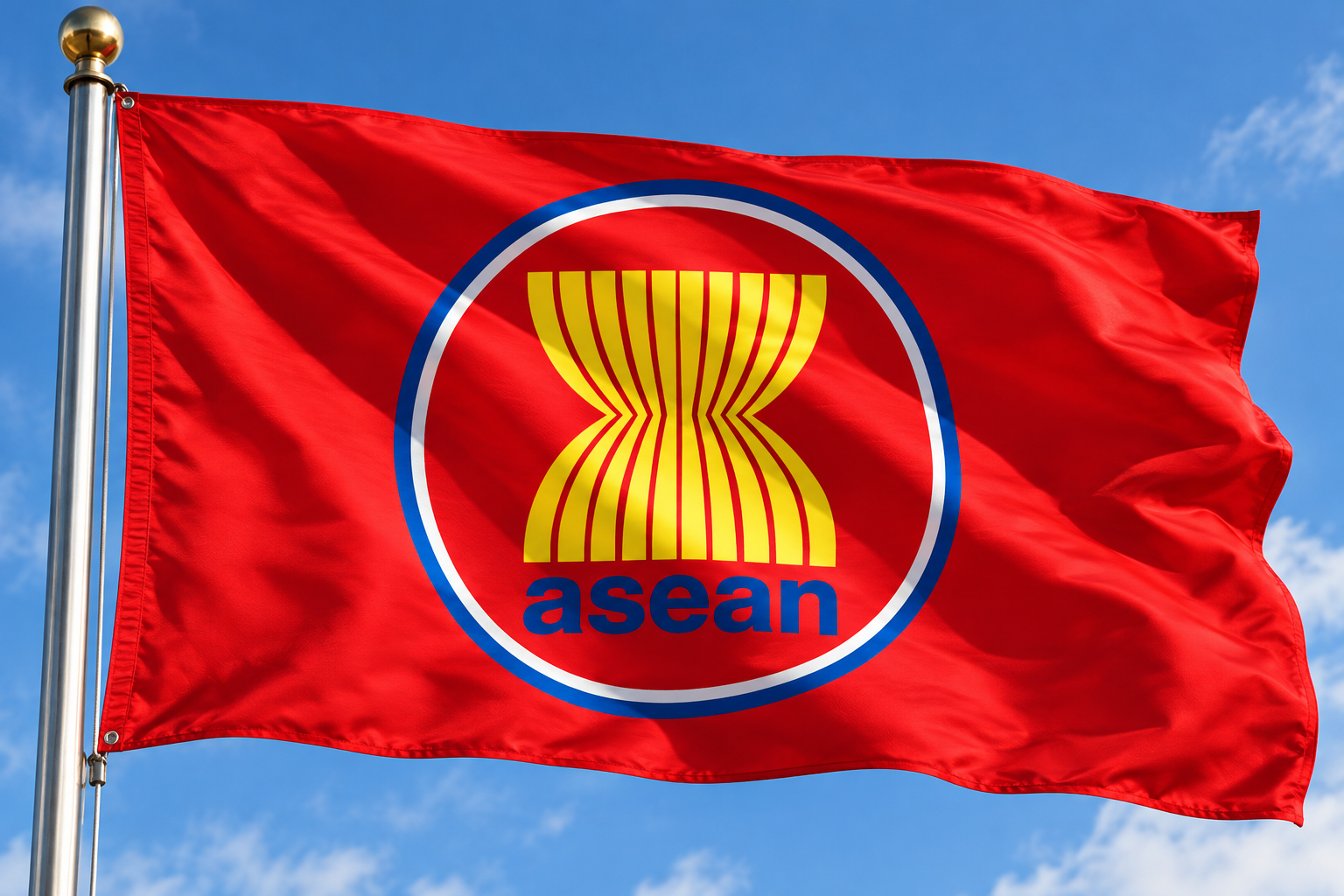
Eleven states, one regional forum
The Association of Southeast Asian Nations (ASEAN) comprises Brunei Darussalam, Cambodia, Indonesia, Lao PDR, Malaysia, Myanmar, the Philippines, Singapore, Thailand, Timor-Leste and Viet Nam. Timor-Leste was admitted as the eleventh member in October 2025. ASEAN coordinates political-security, economic and socio-cultural cooperation while preserving member-state sovereignty.
Its defining institutional approach emphasises consultation, consensus and non-interference. These principles can keep diverse governments engaged, but they also constrain decisive collective action.
Philippine chairmanship and ASEAN 2045
The Philippines chairs ASEAN in 2026 under the theme “Navigating Our Future, Together.” The 48th ASEAN Summit met in Cebu on 8 May 2026. In July, ASEAN foreign ministers reaffirmed implementation of ASEAN 2045: Our Shared Future and its three community pillars.
The admission of Timor-Leste widens regional representation but also creates practical integration and institutional-capacity tasks. The 49th ASEAN Summit is scheduled for November 2026; its prospective outcomes are not treated here as completed decisions.
Atlas distinction: Convening authority, negotiated declarations and implemented policy outcomes are separate measures of institutional centrality.
Six dimensions of regional centrality
ASEAN-led forums
ASEAN convenes wider dialogue through ASEAN Plus Three, the East Asia Summit and the ASEAN Regional Forum.
South China Sea
Overlapping maritime claims, freedom of navigation and international law test the ability to maintain a common regional approach.
Trade and supply chains
Regional trade agreements, logistics, investment and industrial networks connect Southeast Asia to global markets.
US–China rivalry
Different security and economic relationships make a single bloc alignment neither realistic nor desirable for all members.
Technology and connectivity
Digital-economy initiatives seek to reduce fragmentation while managing regulatory and capability gaps.
Resilience and protection
Disasters, displacement, food security, public health and essential services test cooperation beyond diplomacy.
The mechanisms behind ASEAN centrality
Heads of government
Provides high-level political direction for the organisation and its regional agenda.
Coordination and continuity
Supports implementation, institutional administration and cooperation among member states.
Three pillars
Political-Security, Economic and Socio-Cultural cooperation form the core community architecture.
Security dialogue
Brings external partners into dialogue on political and security questions.
Leaders’ dialogue
Offers a wider regional platform for strategic and political consultation.
Inclusive framework
Emphasises openness, dialogue, cooperation and ASEAN-centred regional arrangements.
Where centrality is challenged
Consensus and humanitarian access
The prolonged crisis tests ASEAN’s Five-Point Consensus, diplomatic leverage and capacity to protect civilians.
Rules and restraint
Member states have differing maritime interests and external relationships, complicating negotiations and common positions.
Interstate tensions
Border disputes highlight the tension between non-interference, preventive diplomacy and regional conflict management.
Institutional inclusion
Full participation requires sustained capacity-building and integration across ASEAN bodies.
Strategic autonomy
Economic dependence and security relationships vary sharply across the eleven members.
Operational solidarity
Extreme weather and humanitarian emergencies reveal the difference between coordination mechanisms and field capacity.
Centrality is not the same as control
ASEAN’s ability to bring powers together does not mean it can compel them to act. Consensus can sustain institutional unity but may dilute decisions, delay responses or leave implementation to individual governments. Its members have divergent political systems, maritime interests, economic dependencies and security arrangements.
External partners may support ASEAN-led platforms while simultaneously pursuing bilateral and smaller-group arrangements outside ASEAN. This creates a continuing test of relevance rather than proof of institutional decline.
Convening power must become problem-solving capacity
ASEAN is a central example of institutional influence without supranational authority. Its comparative strength is the ability to sustain dialogue across geopolitical divides; its vulnerability is the gap between consultation and collective response when crises require speed, accountability and difficult political choices.
Atlas assessment: ASEAN centrality should be measured by whether its forums reduce escalation, uphold agreed rules and deliver practical benefits for people—not only by the number of meetings they convene.
Regional agency in a multipolar world
Atlas Protocol assesses ASEAN through its effects on civilian safety, humanitarian access, maritime stability, food and energy security, economic resilience and institutional accountability. The objective is not to impose a single geopolitical alignment on Southeast Asia, but to examine whether regional institutions can preserve meaningful choices for their members and populations.
Official ASEAN records
Assessment cutoff: 18 October 2026. Official institutional positions are distinguished from independent Atlas analytical judgments.

Understanding complexity. Supporting decisions. Putting people first.