
G20 — Global Economic Coordination
The G20 brings major economies together to coordinate responses to shared economic challenges. Its influence depends less on binding authority than on the political willingness of members to turn common priorities into action.
Institutional assessment · 18 October 2026
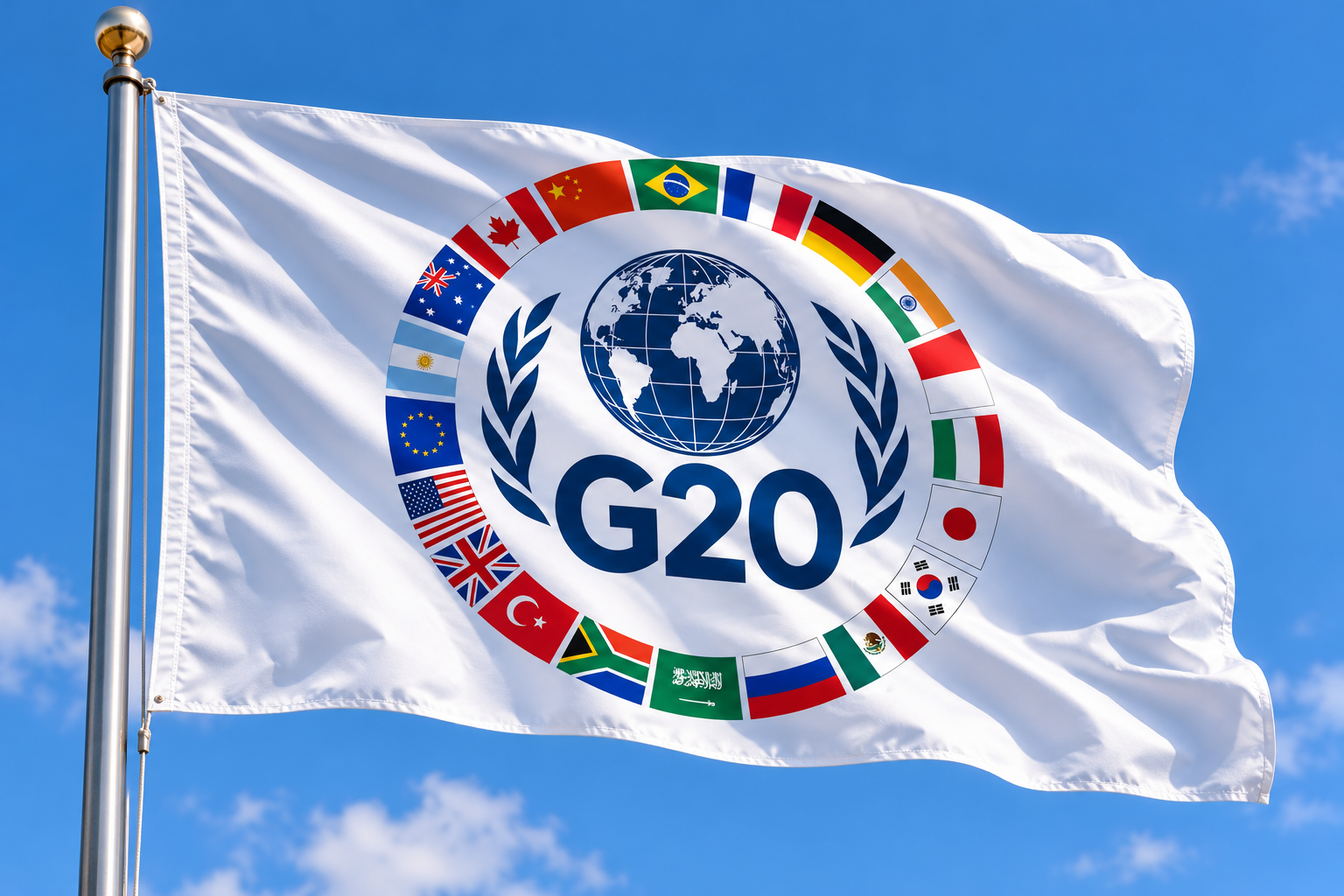
An influential forum without supranational authority
The Group of Twenty consists of 19 countries and two regional organisations: the European Union and the African Union. It emerged as a finance ministers’ forum in 1999 and began meeting at leaders’ level in 2008. The African Union became a permanent member in 2023.
The G20 is not a treaty-based global government. Its declarations and coordinated initiatives are politically important, but implementation remains with members and relevant international institutions.
The United States presidency and its priorities
The United States holds the 2026 G20 presidency. The presidency has prioritised economic growth, regulatory approaches, secure and affordable energy supply chains, innovation and technology. The finance track has focused on global imbalances, sovereign debt transparency and restructuring, cross-border payments, financial regulation and digital assets.
At the August–September 2026 finance ministers and central bank governors meeting in Asheville, participants addressed growth, debt, financial-sector questions and disruptions to energy and other critical supply chains. The chair’s statement recorded reservations by China on several paragraphs; this distinction matters when assessing the extent of actual consensus.
The leaders’ summit is scheduled for 14–15 December 2026 in Miami. As of this assessment date, that summit has not yet taken place.
Six pressures shaping economic coordination
Uneven economic performance
Different growth trajectories, inflation pressures and fiscal capacities make common policy difficult.
Sovereign financing and restructuring
Debt transparency and workable restructuring mechanisms matter especially for vulnerable economies.
Fragmentation and supply chains
Trade restrictions, industrial policies and disruptions challenge predictability and cooperation.
Security and transition
Energy affordability, reliable supply and climate objectives create competing priorities.
AI, payments and digital finance
New technologies can improve productivity while creating regulatory and financial-stability risks.
Legitimacy and inclusion
African Union membership broadens representation, but voice does not automatically translate into influence.
Where the G20 can shape outcomes
Political direction
Leaders set high-level priorities and can unlock cooperation across ministries and institutions.
Macroeconomic and financial issues
Finance ministries and central banks address debt, stability, payments and global imbalances.
Cross-sector coordination
Officials coordinate issues beyond finance, with priorities varying by presidency.
Operational partners
International financial institutions supply analysis, financing and implementation channels; they are distinct from the G20.
Standards and monitoring
The FSB helps coordinate international financial regulatory and supervisory work.
Regional representation
The two regional members participate alongside sovereign states, introducing broader institutional perspectives.
Consensus is not the same as compliance
G20 members differ over trade policy, sanctions, climate commitments, development finance and the role of the state in economic growth. A rotating presidency can focus attention, but can also narrow the agenda. Political declarations do not independently establish whether promised reforms were funded, enacted or delivered.
The forum’s legitimacy also depends on whether policies serve populations beyond its membership and whether developing countries have a meaningful role in shaping outcomes.
Coordination must be measured through delivery
The G20 is a useful institutional barometer of the global system’s capacity to cooperate despite geopolitical competition. Its success should be judged by concrete improvements in economic resilience, debt outcomes, financial stability, cross-border functionality and the protection of essential supply chains—not by the number of declarations issued.
Atlas assessment: The G20’s power is convening power. Its credibility is determined by what members implement after they leave the negotiating table.
Economic policy has human consequences
Global economic coordination affects food and energy affordability, employment, health systems, access to finance and the ability of governments to maintain essential services. Atlas Protocol distinguishes the forum’s stated objectives from measurable impacts on people and institutions.
Institutional and official resources
Assessment cutoff: 18 October 2026. Political commitments, chair statements and independently assessed implementation are treated separately.

Understanding complexity. Supporting decisions. Putting people first.