
UK–EU: European Strategic Realignment
Beyond Brexit, the United Kingdom and European Union are rebuilding selective cooperation in security, industry and shared resilience — without reversing their distinct political and legal positions.
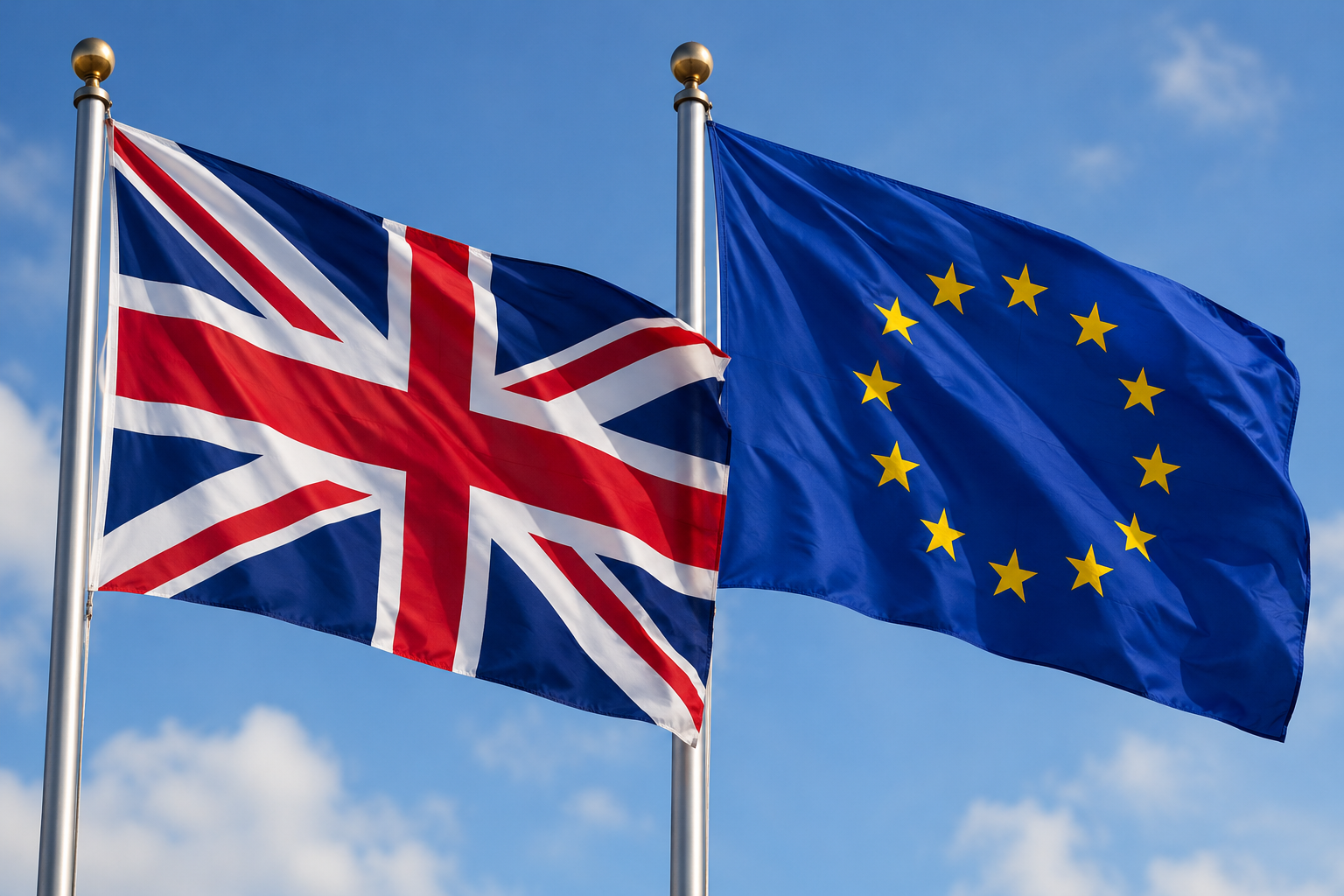
Cooperation without reintegration
The UK left the European Union in 2020. Their relationship rests on the Withdrawal Agreement, including the Windsor Framework, and the Trade and Cooperation Agreement. At the London summit on 19 May 2025, both sides agreed a new strategic partnership and a Security and Defence Partnership. These instruments support closer coordination while preserving separate decision-making authority.
Atlas question: Can two politically distinct actors increase European strategic capacity without reproducing the institutional integration that Brexit ended?
Six dimensions of strategic realignment
Shared European security
Russia’s war against Ukraine and wider security risks create incentives for closer coordination, including sanctions, crisis response and military mobility.
Industrial capacity
Defence procurement, industrial interoperability and potential cooperation on European instruments remain consequential but subject to negotiated access and legal limits.
Trade frictions and resilience
Reducing unnecessary barriers in agrifood trade and improving supply-chain resilience can deliver practical benefits without restoring single-market membership.
Cyber, space and hybrid threats
The 2025 partnership explicitly covers cybersecurity, space security, information interference and critical infrastructure resilience.
Interconnected systems
Electricity-market cooperation and potential emissions-trading linkages illustrate how shared infrastructure creates mutual incentives.
Mobility and legitimacy
Possible youth mobility arrangements and practical border cooperation will be judged by reciprocity, democratic consent and concrete outcomes.
A partnership grounded in existing agreements
The 2025 summit produced a joint statement, a Security and Defence Partnership and a Common Understanding on renewed cooperation. These establish political and operational directions, not a return to EU membership. NATO remains the cornerstone of collective defence for the UK and EU members that belong to the alliance. The EU and UK retain distinct institutions, laws and sovereign political choices.
The 20 November 2026 Brussels summit
The second EU–UK summit is scheduled for 20 November 2026 in Brussels. The UK government and European Council have confirmed the meeting. Its agenda includes reviewing progress and seeking practical advances on security, economic cooperation and barriers affecting businesses. Any agreement remains prospective until formally announced and documented.
Evidence discipline: A scheduled summit is not evidence that negotiations have concluded or that proposed arrangements are in force.
Realignment has structural limits
Autonomy versus access
Closer participation in EU programmes or markets may require negotiated conditions, oversight and regulatory alignment.
Domestic durability
Public mandates and political leadership on both sides can affect the scope and continuity of cooperation.
From declarations to delivery
Defence readiness, border simplification and energy integration depend on funding, detailed agreements and implementation.
Selective convergence, not a new bloc
The UK–EU relationship demonstrates functional realignment: two actors can rebuild cooperation in selected strategic domains while remaining institutionally separate. Its multipolar significance is the possibility of greater European capacity to respond to shocks, coordinate with allies and reduce fragmentation. Yet the degree of autonomy achieved will depend on operational results, not summit language alone.
This is an independent Atlas Protocol interpretation. It does not imply UK accession to the EU, a single European foreign policy, or a guaranteed outcome at the forthcoming summit.
Strategic alignment is credible when it improves the ability to act together without concealing the limits of agreement.
Capability, accountability and cooperation
Atlas Protocol assesses this relationship through three questions: does cooperation measurably improve collective resilience; does it respect democratic accountability and legal autonomy; and does it reinforce established international obligations rather than displace them? The institutional mechanisms are examined under Institutions; the redistribution of strategic choices belongs under Multipolarity.
Evidence and verification
European Council — EU–UK summit, 20 November 2026 ↗UK Government — announcement of the 20 November summit ↗European Council — EU–UK summit outcomes, 19 May 2025 ↗UK Government — Security and Defence Partnership text ↗European Commission — renewed agenda for cooperation ↗Assessment cutoff: 18 October 2026. Future summit outcomes are not presumed. Atlas Protocol is an independent analytical initiative.

Understanding complexity. Supporting decisions. Putting people first.