
Where geopolitics becomes business reality.
Power shifts, trade policy, technology, energy, supply chains and strategic dependencies increasingly shape the environment in which companies compete, invest and grow.
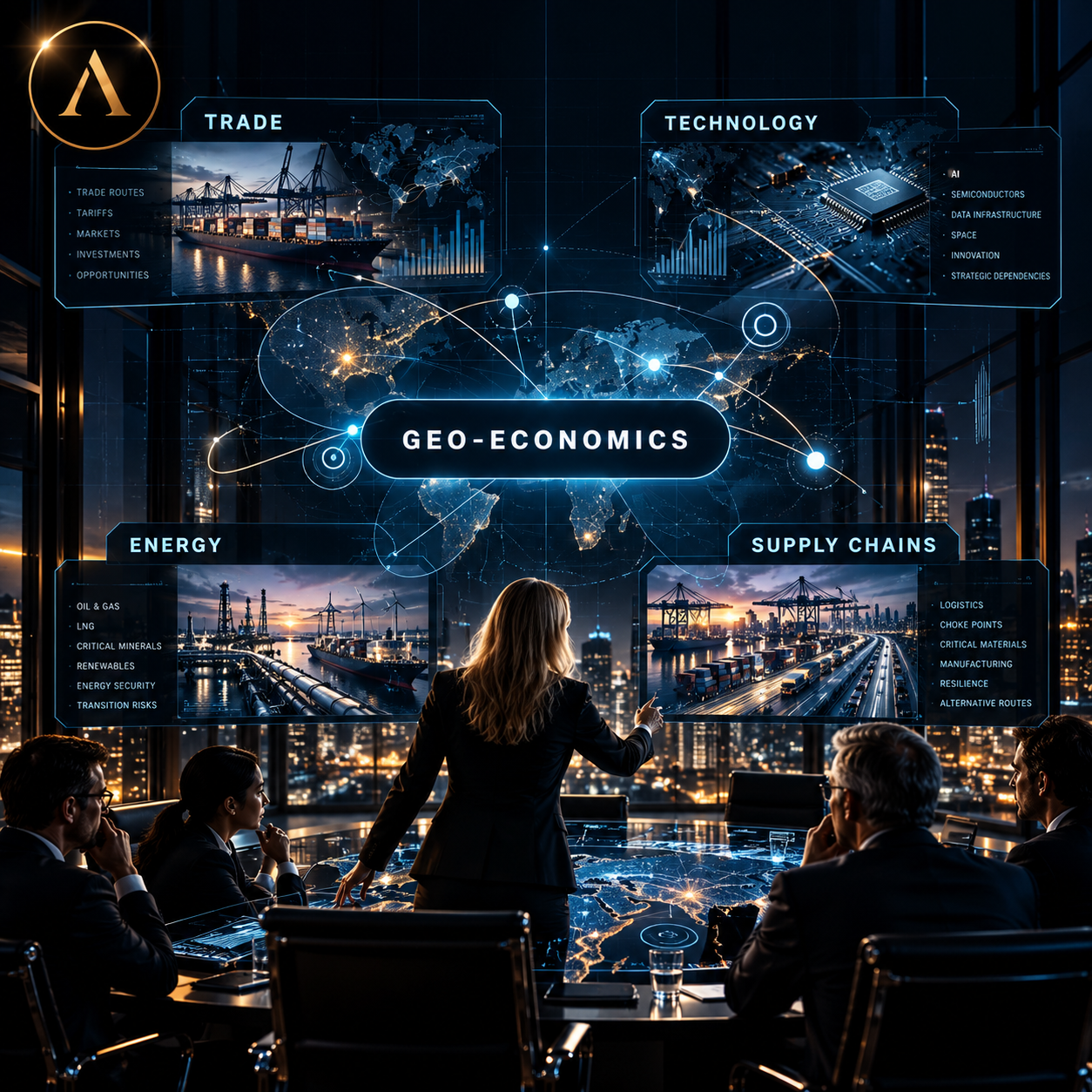
Industrial policy, sanctions, strategic autonomy, energy security, critical technologies, infrastructure, regulation and geopolitical rivalry increasingly influence commercial reality. For CEOs and management teams, understanding these forces is becoming part of understanding the business itself.
The forces outside the company that can change what is possible inside it.
Geo-economic intelligence connects global developments to concrete questions of exposure, resilience, investment, market position and growth.
Where are the hidden dependencies?
Map critical suppliers, corridors, choke points, infrastructure and geopolitical concentrations that may affect continuity.
What happens when access, price or policy changes?
Connect energy, critical materials and resource dependencies to strategic and operational exposure.
Where is policy reshaping competition?
Track tariffs, subsidies, strategic autonomy, localisation and industrial policy as they alter market conditions.
Which technologies are becoming geopolitical assets?
Assess AI, semiconductors, digital infrastructure and strategic technology through both competitive and geopolitical lenses.
Where can geopolitical change alter value?
Examine investment exposure, market access, financial pressure and the strategic consequences of shifting alliances.
Which external pressures are becoming business conditions?
Connect regulatory, environmental, social and governance developments to strategic decisions and long-term positioning.
From global event to business consequence.
A geopolitical development only becomes strategically useful when its consequences for the organisation can be understood.
What changed?
Identify the geopolitical, economic, technological or regulatory development.
Where does it touch us?
Connect the change to markets, assets, suppliers, customers, capital and dependencies.
What could follow?
Map direct, second-order and systemic consequences under different scenarios.
What can we do?
Identify strategic responses, trade-offs, timing questions and room for manoeuvre.
Where can we move?
Look beyond defence to new markets, partnerships, incentives and strategic advantage.
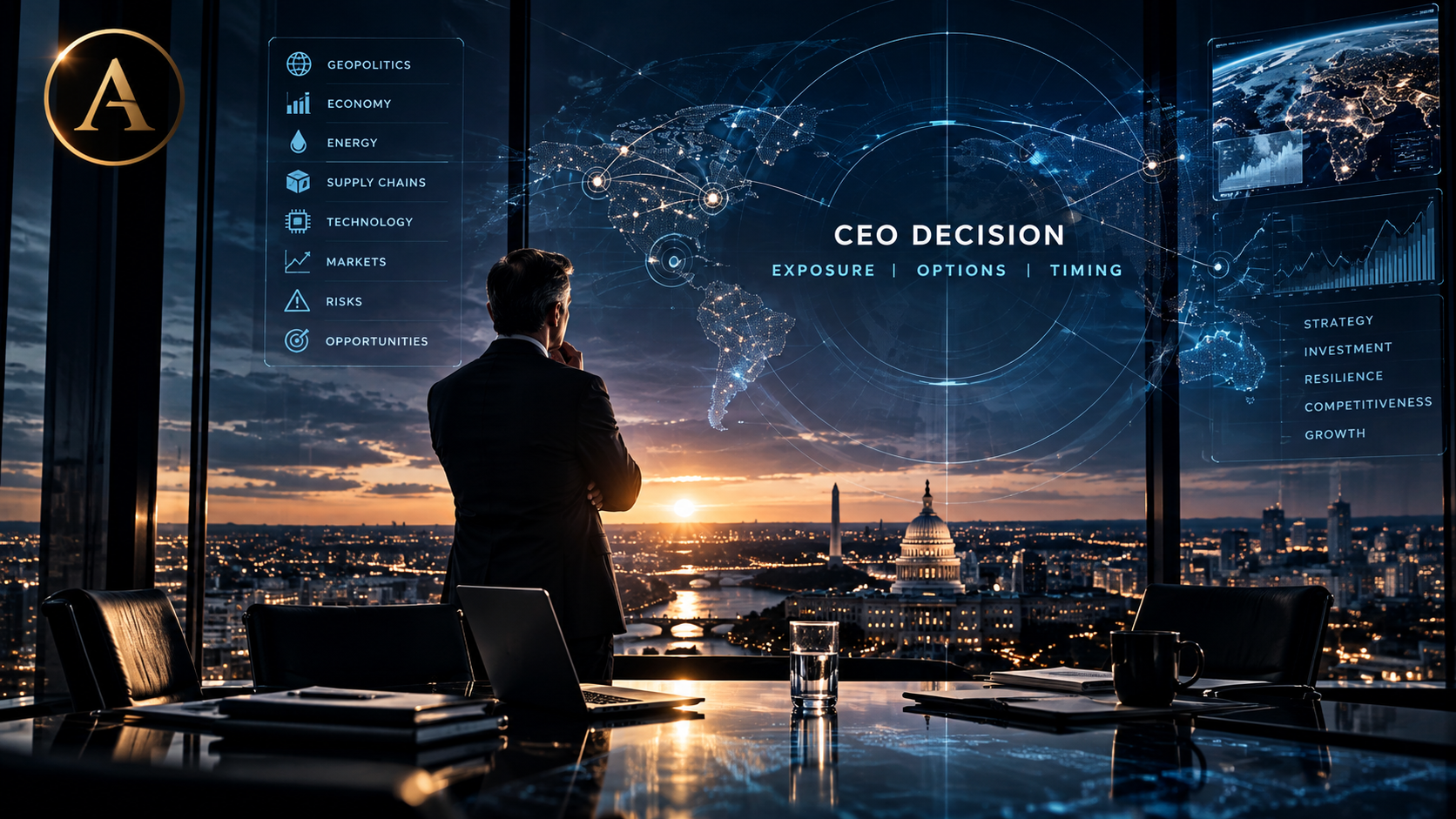
You do not need a geopolitical question. Start with the business decision.
Atlas works backwards from the decision your CEO or management team needs to make — then identifies the geo-economic forces that may change the answer.
Geo-economic change creates opportunity too.
Atlas looks not only at what may go wrong, but at where policy, investment, alliances, technology and changing supply structures may create new room for growth.
The objective is not to turn executives into geopolitical experts. It is to make the external forces that matter visible early enough to inform strategy, investment, resilience and growth.
From focused exposure to continuous strategic awareness.
Global signals become business intelligence through one connected architecture.
Atlas LIVE
Global signals, infrastructure, conflicts and systemic developments brought together as events evolve.
Enter Atlas LIVE → 02UNDERSTANDIntelligence Core
Seven analytical layers connect developments into one systemic picture.
Explore Intelligence Core → 03ANTICIPATEStrategic Intelligence
Daily Intelligence, GSSCM and thematic intelligence identify what may matter next.
Explore Strategic Intelligence → 04DECIDEAtlas Institute
Global intelligence is translated into business exposure, options, opportunity and decision support.
Explore Atlas Institute →Geopolitical and economic change will reach the company through markets, energy, technology, regulation, supply chains and capital. The strategic advantage is understanding where — and what to do about it — before the consequence becomes obvious.

Understanding complexity. Supporting decisions. Putting people first.