
Gulf States — Strategic Hedging
The six Gulf Cooperation Council states are navigating a contested regional order through overlapping security, economic and diplomatic partnerships. Their choices reveal both the opportunities and limits of multipolarity.
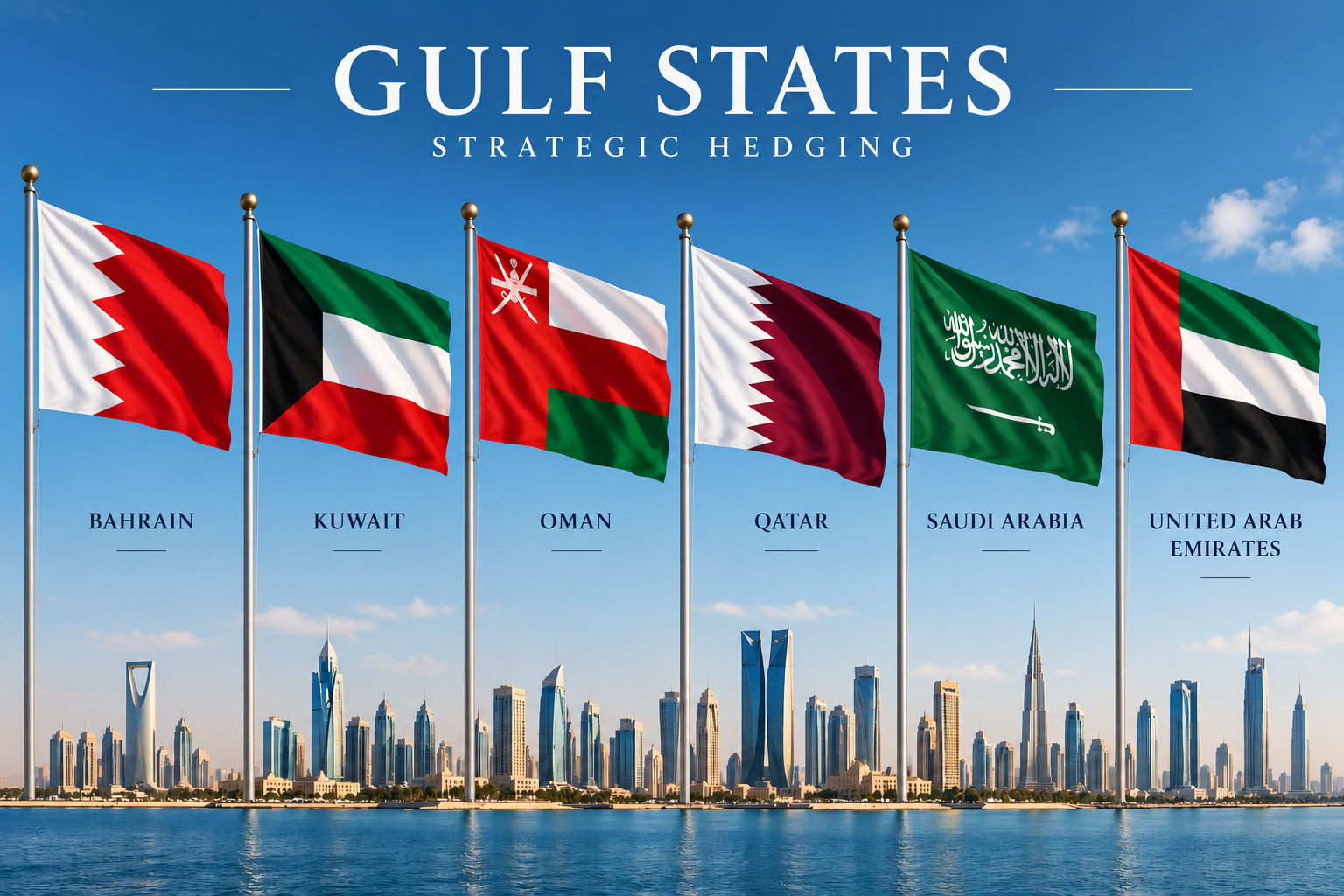
Six states, different strategic calculations
The Gulf Cooperation Council (GCC) comprises Bahrain, Kuwait, Oman, Qatar, Saudi Arabia and the United Arab Emirates. It provides a framework for regional coordination, but does not eliminate differences in national interests, external partnerships or diplomatic methods. For Atlas Protocol, the subject is not simply the GCC as an institution: it is the distinct strategies of six states operating between external powers and regional pressures.
Atlas question: Can diversified partnerships increase Gulf states’ strategic autonomy when maritime security and regional escalation remain highly exposed to military confrontation?
Hormuz security and deeper EU–GCC engagement
The Strait of Hormuz has remained central to regional security and international energy flows. In July 2026, EU and GCC representatives jointly reaffirmed freedom of navigation under international law. On 16 October, the GCC Secretary-General addressed the European Parliament on regional security and the strategic partnership with Europe. The EU reports that all six GCC members have agreed to engage in negotiations on bilateral strategic partnership agreements; negotiations are not equivalent to concluded agreements.
Scheduling note: The second EU–GCC summit originally planned for 24 October 2026 has been postponed; no new date is confirmed in the cited European Council notice.
Six dimensions of Gulf strategic hedging
Hormuz and critical passage
Shipping security, energy exports and civilian supply chains remain vulnerable to regional confrontation and disruption.
US defence relationships
American military capacity remains important to Gulf security, even as governments seek additional diplomatic and economic options.
Asia, Europe and diversification
Trade, investment, energy demand and industrial diversification deepen links with China, India, the EU and other partners.
Hydrocarbons and future systems
Oil and gas revenues coexist with investment in renewables, hydrogen, logistics and industrial transformation.
Mediation and de-escalation
Gulf governments use different channels for negotiation, crisis mediation and regional accommodation.
Technology and sovereign investment
Capital, infrastructure, digital capabilities and state-led investment expand influence but do not remove geopolitical exposure.
The GCC is not a single foreign-policy actor
Security and regional coordination
A closely integrated Gulf security partner, with a strong interest in collective protection and institutional cooperation.
Institutional caution
Balances security partnerships with parliamentary and diplomatic traditions and a preference for regional stability.
Diplomatic bridge-building
Maintains a distinctive tradition of mediation, dialogue and engagement across regional divides.
Mediation and international networks
Uses diplomacy, energy exports and international partnerships to expand influence beyond its territorial scale.
Regional and economic scale
Combines energy weight, domestic transformation and regional diplomacy with broad external partnerships.
Trade, logistics and strategic reach
Builds influence through commercial connectivity, technology, investment and diversified international relationships.
Partnerships differ by issue and country
Security anchor
Defence cooperation and deterrence remain important, but do not determine every Gulf economic or diplomatic choice.
Institutional and commercial engagement
Trade, energy, investment and maritime security provide expanding channels of cooperation.
Trade and technology
Energy demand, infrastructure, investment and technology create incentives for closer economic relations.
Energy and connectivity
Labour, investment, shipping, technology and energy connect Gulf development with South Asian growth.
Iran and neighbouring powers
Geography requires crisis management and selective dialogue even where security interests sharply diverge.
Issue-based cooperation
Gulf states also engage with other Asian, African and international partners depending on the policy domain.
Hedging is not immunity
Diversification does not remove dependence on maritime chokepoints, foreign defence systems, imported technologies, global capital flows or hydrocarbon revenues. Domestic political systems and human-rights records also shape the legitimacy of external partnerships. Regional rivalries and unequal state capabilities can limit common GCC action. The six governments should therefore not be treated as a unified strategic bloc.
Analytical distinction: Multiple partnerships can increase bargaining options without producing full strategic autonomy.
Selective diversification under security pressure
The Gulf illustrates strategic hedging under asymmetric dependence. Governments cultivate multiple economic and diplomatic relationships while continuing to rely heavily on established security arrangements. This is not necessarily neutrality, nor evidence of a coherent alternative international order.
The decisive test is behaviour during crises: whether diversified ties support de-escalation, freedom of navigation and resilient civilian systems—or simply redistribute leverage among competing powers. National differences remain analytically essential.
People before power in a critical corridor
Atlas Protocol evaluates Gulf strategic choices through the effects on civilian protection, essential services, energy affordability, food and medicine supply chains, maritime workers and humanitarian access. Institutional cooperation matters when it reduces exposure to escalation and improves accountability across borders.
More partners do not automatically mean more security. The human consequences of strategic decisions remain the measure.
Evidence and verification
GCC Secretariat — Member States ↗European Commission — EU–Gulf relations ↗European Council — Second EU–GCC summit postponed ↗EEAS — Hormuz and freedom of navigation, 13 July 2026 ↗GCC Secretariat — GCC–EU parliamentary meeting, 16 October 2026 ↗Chatham House — How will the Iran war reshape the Persian Gulf? (analysis) ↗Assessment cutoff: 18 October 2026. Official statements are attributed to their issuing bodies; independent analytical judgments are distinguished from reported events. Atlas Protocol is an independent analytical initiative.

Understanding complexity. Supporting decisions. Putting people first.