
India — Strategic Multi-Alignment
India engages competing centres of power without accepting exclusive alignment. Its strategic autonomy is a defining test of how multipolarity operates in practice.
Partnerships without exclusive blocs
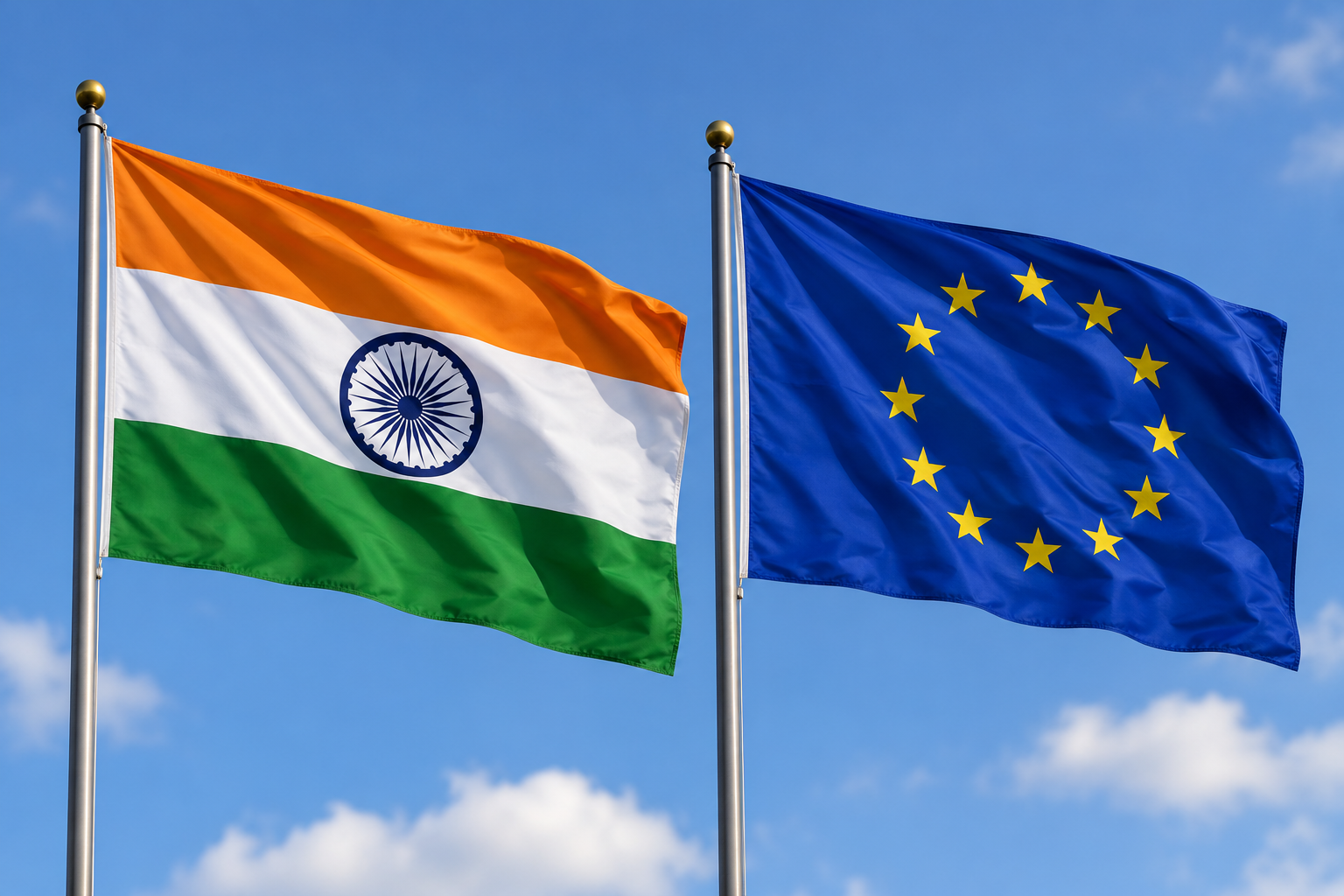
India’s foreign policy combines long-standing strategic autonomy with active engagement across institutions, security dialogues and economic partnerships. New Delhi participates in BRICS and the Shanghai Cooperation Organisation (SCO), while cooperating with the United States, Japan and Australia through the Quad and deepening ties with the European Union. These arrangements have different purposes and obligations; participation does not make them a single alliance.
Atlas question: Can India expand its freedom of action through multiple partnerships while managing the contradictions among them?
EU–India agreements: progress with legal steps outstanding
At the EU–India summit on 27 January 2026, both sides announced the conclusion of free-trade agreement negotiations and signed a security and defence partnership. In September 2026, the European Commission proposed Council authorisation for signature and conclusion of the trade agreement. Negotiations concluded does not mean that the trade agreement has entered into force. These developments show the expansion of India’s options, not a shift into an exclusive European alignment.
Six dimensions of Indian multi-alignment
Indo-Pacific balance
Maritime security and the China challenge create incentives for cooperation with Quad partners without a mutual-defence treaty.
BRICS, SCO and G20
India works through overlapping forums to advance development priorities and seek greater representation in global governance.
Trade and industrial capacity
Supply-chain diversification, domestic manufacturing and investment partnerships are tools of economic autonomy.
Digital and strategic capabilities
Semiconductors, digital public infrastructure, space and critical technologies connect national capacity with international cooperation.
Representation and development
India presents itself as a voice for developing economies, while its own interests do not always coincide with those of every Global South partner.
Russia and strategic continuity
Legacy defence relationships, energy considerations and diplomacy with Moscow complicate Western expectations of alignment.
The limits of simultaneous engagement
Competition and interdependence
Border security concerns and Indo-Pacific rivalry coexist with economic interdependence and shared participation in BRICS and SCO.
Cooperation and friction
Defence and technology cooperation are substantial, but trade disputes and differing positions on Russia can strain the relationship.
Continuity under pressure
Defence and energy ties offer continuity but expose India to geopolitical, financial and sanctions-related pressures.
Strategic autonomy is not cost-free
Multi-alignment can preserve options, but it also increases exposure to incompatible expectations. Defence dependence, energy security, border tensions, technology restrictions, trade negotiations and domestic development needs can narrow India’s room for manoeuvre. Membership in several forums does not guarantee consensus or operational influence.
Analytical distinction: Diplomatic access, strategic autonomy and actual decision-making capacity are related but not interchangeable.
A pivotal actor, not a neutral intermediary
India illustrates selective multi-alignment: cooperation is calibrated by issue, partner and national interest. Its position cannot be reduced to a Western, Chinese or Russian camp. Nor should strategic autonomy be mistaken for neutrality: India takes substantive positions and makes choices with consequences for other actors.
The multipolar significance lies in the ability of major states to pursue overlapping partnerships that resist rigid bloc boundaries. Whether this strengthens collective stability depends on crisis behaviour, institutional reform and practical cooperation rather than diplomatic symbolism alone.
Representation, responsibility and human consequences
Atlas Protocol evaluates India’s growing influence against three tests: whether institutional representation becomes more legitimate, whether competing partnerships produce concrete cooperation, and whether strategic decisions reduce or transfer risks to civilian populations. This assessment is independent of any government or geopolitical bloc.
More centres of power do not automatically create a more accountable international order.
Evidence and verification
European Council — EU–India summit, 27 January 2026 ↗European Commission — EU trade relations with India ↗SCO — India and SCO cooperation, May 2026 ↗Government of India — strategic autonomy statement, September 2026 ↗Carnegie Endowment — India and a changing global order (analysis) ↗Assessment cutoff: 18 October 2026. Negotiated, signed and legally effective agreements are distinguished. Atlas Protocol is an independent analytical initiative.

Understanding complexity. Supporting decisions. Putting people first.