
STR 05 — Strategic Domains
Strategic systems are where geopolitical pressure becomes operational reality. Defence and resilience, maritime corridors, financial networks, human security, artificial intelligence and orbital infrastructure shape how risks propagate — and where informed decisions may still contain them.
Explore strategic dossiers ↓From interconnected pressure to strategic decisions
Strategic vulnerabilities can spread across domains: shipping disruptions affect energy and prices; cyber events may interrupt essential services; decisions made under uncertainty can accelerate escalation.
Atlas interpretation: STR 05 examines pathways of exposure, escalation and resilience rather than claiming operational command or enforcement authority.
Strategic effects → Geopolitical response
PLN 01 examines physical planetary conditions; STR 05 assesses how exposed systems can be protected or used under pressure; GEO 06 addresses interstate dynamics and strategic alignment. OBS 07 supports evidence and early warning.
Explore GEO 06 →Six strategic systems
Eight strategic intelligence dossiers
Select a dossier to read its strategic overview and access the full document.







D.E.F.E.N.D.
Atlas Protocol analytical framework · Updated 22 October 2026 · For strategic assessment; not an assertion of institutional authority.
Executive strategic assessment
Global defence can no longer be evaluated solely through armed-force readiness. Cyber systems, orbital services, maritime corridors, energy grids, financial connectivity, public-health capacity and the civilian fabric are intertwined. A disruption in one domain can propagate into the others, shortening the time available for legitimate decision-makers to act.
D.E.F.E.N.D. provides a multidomain framework for comparing exposure, redundancy, response readiness, escalation pathways and recovery capacity. Its principal strategic test is not whether all conflict can be prevented, but whether societies can protect essential functions while reducing avoidable escalation.
1. Strategic premise
The original March 2026 proposition remains the intellectual anchor: reduce the frequency of conflict activation without reducing the capacity to respond. Deterrence and lawful defence remain indispensable; equally indispensable are reliable verification, institutional accountability, civil preparedness and credible off-ramps from crises.
Earlier assertions that global security is categorically “underfunded” or “misallocated” cannot be sustained as universal factual findings without comparative evidence. The revised claim is narrower: imbalances among defence, prevention and resilience may create avoidable strategic vulnerability. Each case requires empirical assessment.
5. Analytical operating cycle
01 Detect — Collect geographically balanced, traceable indicators and identify departures from baseline.
02 Verify — Separate reported incidents, corroborated observations, analytical inference and uncertainty.
03 Map — Identify interconnected systems, plausible propagation pathways, human consequences and competing explanations.
9. Principles and safeguards
No private mandate: D.E.F.E.N.D. is an analytical lens, never a standing intervention authority.
No assumed escalation certainty: scenario chains must distinguish possibility from probability and evidence from hypothesis.
No geographic hierarchy: all major power blocs, including non-Western sources, are assessed by the same analytical criteria.
MCP-5
Atlas Protocol analytical framework · Updated 22 October 2026 · For strategic assessment; not an assertion of institutional authority.
EXECUTIVE ASSESSMENT
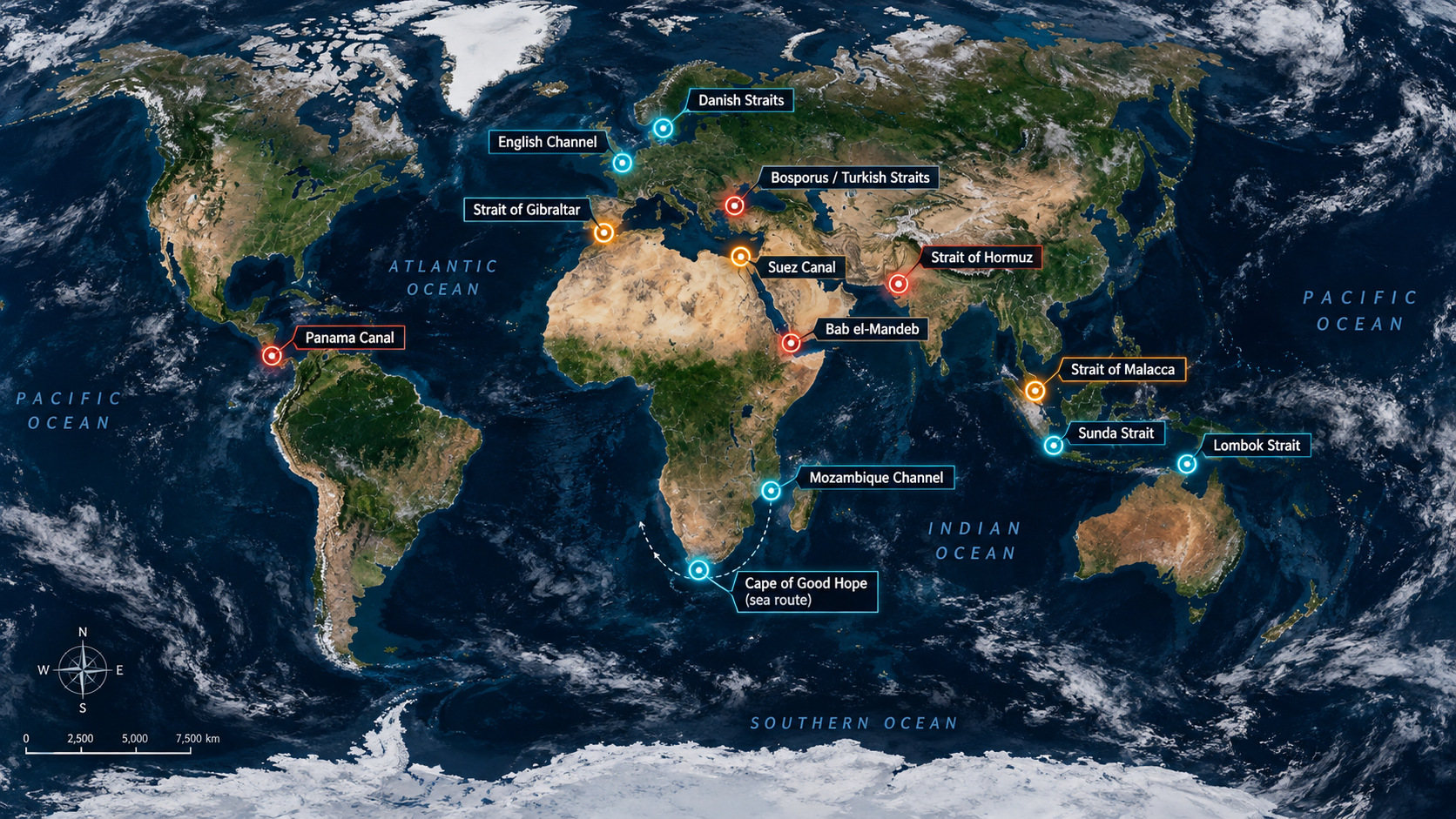
Maritime chokepoints concentrate global dependencies within narrow, politically exposed geography. A disruption can propagate through shipping capacity, energy markets, food security, insurance, financing and civilian welfare. MCP-5 therefore treats access and continuity not simply as naval matters, but as interconnected strategic-resilience questions.
UNCTAD reports that more than 80% of international merchandise trade by volume moves by sea (2025). This is a volume statistic, not a claim about trade value. Route-specific market shares vary with the commodity, reference year, routing and chosen denominator. [S1]
02 THE FIVE MCP-5 CORRIDORS
Methodological note: MCP-5 is not an exhaustive list. Panama Canal, Danish Straits and other high-impact passages also merit comparative monitoring. The Bosporus is analysed as part of the interconnected Turkish Straits system; the Dardanelles should not be conflated with the Bosporus when quoting transit datasets.
04 DISRUPTION TRANSMISSION MODEL
Feedback loops matter: repricing can change routing; rerouting can create new bottlenecks; disinformation can amplify or distort perceived risk. GFSM provides a complementary financial contagion perspective while OBS 07 supplies evidence grading and trend recognition.
05 MCP-5 MONITORING & DECISION LOGIC
Operational sequence: (1) verify incident; (2) characterize affected corridor and users; (3) model alternative routing and exposure; (4) assess escalation pathways; (5) compare response options and civilian consequences; (6) update confidence and assumptions. No unverified numerical risk index is implied by this document.
06 GOVERNANCE, INTERNATIONAL LAW & LIMITS
Navigation rights, coastal-state jurisdiction, transit regimes, shipping safety obligations and sanctions are governed by applicable international law and national mandates, not by MCP-5. Any new collective-protection initiative would require negotiated legal authority, credible burden-sharing and explicit safeguards for sovereignty and civilian access.
Under the proposed UNv7 Global Chokepoint Protection Principle, Atlas can formulate a *normative recommendation* for uninterrupted essential access, neutral verification and cooperative contingency planning. The principle is not an adopted UN instrument. Maritime monitoring must respect evidentiary integrity and avoid treating a proposed protocol as an enforceable rule.
UNv7
Atlas Protocol analytical framework · Updated 22 October 2026 · For strategic assessment; not an assertion of institutional authority.
Executive assessment
Maritime chokepoints carry energy, food, medical supplies and industrial inputs through geographically concentrated passages. Disruption can propagate into price shocks, transport delays, security incidents and humanitarian exposure. Existing law already regulates several forms of passage; the proposed UNv7 contribution is to strengthen prevention, coordination and civilian-impact assessment within competent legal and institutional mandates.
This document proposes ten principles. Its provisions should be read as recommendations for voluntary adoption, negotiated arrangements or future competent decisions; no Atlas body can issue binding orders, establish UN mechanisms or suspend national rights.
2 | Legal and institutional boundary
The UN Convention on the Law of the Sea (UNCLOS) differentiates transit passage through certain straits, innocent passage and other navigational regimes. Article 44 provides that states bordering straits shall not hamper transit passage and that it shall not be suspended; Articles 38–43 detail scope, duties, coastal-state regulations and cooperation. Other passages may be subject to different rules or specific treaty regimes. It would be inaccurate to declare every closure, restriction or security measure categorically unlawful in every waterway.
The UNv7 proposal therefore operates through: applicable international law; sovereign consent where required; competent national and international institutions; and independently documented procedures. A no-veto preference is a policy proposal, not a power to override the UN Charter or binding decision rules.
Article 3 — Continuity of lawful navigation
Participating states and institutions should seek to prevent coercive interruption of lawful navigation, consistent with the applicable navigational regime, legitimate coastal-state rights, maritime safety obligations and binding international rules.
Article 4 — Sovereignty and shared responsibility
The proposal does not transfer sovereignty or jurisdiction. Coastal states retain rights and duties under applicable law; flag states, port authorities, operators and affected states share responsibilities appropriate to their mandates. Cooperative safeguarding should be based on consent, proportionality and non-discrimination where the governing law requires it.
Article 7 — Conduct to be discouraged or prevented
The proposed framework opposes coercive restrictions, discriminatory denial of lawful access, threats against civilian shipping and exploitation of chokepoints for unlawful pressure. The legal character of any specific measure must be assessed case by case under UNCLOS, relevant treaties, UN Charter obligations, national law and applicable humanitarian law.
Doctrinal boundary: UNv7 and the Global Chokepoint Protection Principle are proposals by Atlas Protocol, not adopted international law or an established UN mandate.
GFSM
Atlas Protocol analytical framework · Updated 22 October 2026 · For strategic assessment; not an assertion of institutional authority.
Executive strategic assessment
Finance is both an economic coordination mechanism and a strategic domain. The same networks that enable investment, trade and liquidity can transmit sudden shocks across borders and institutions. GFSM maps those pathways and identifies the decisions required before a local disruption becomes a systemic event.
The guiding question is not whether volatility can be eliminated. It is whether dependencies are sufficiently visible, safeguards sufficiently robust and responses sufficiently coordinated to prevent cascading failure.
01 | Five core financial functions
These functions are mutually reinforcing: breakdown in one can undermine the reliability of the others.
06 | GFSM ↔ GSSCM interface
GFSM and the Global Stability & Sovereign Capacity Monitor (GSSCM) are complementary but distinct. GFSM describes how financial systems work and transmit instability. GSSCM provides country- and system-oriented capacity, vulnerability and resilience context. A GFSM analyst may consult relevant GSSCM evidence when assessing exposure or response capacity.
Reference: https://septem7.org/dashboard/atlas-protocol-gssc-monitor
GFSM ↔ GSSCM: GFSM maps financial transmission and systemic risk. GSSCM provides distinct country/system-capacity evidence; no automated mapping or common score is claimed. GSSCM Monitor ↗
Arctic Strategic File
Atlas Protocol analytical framework · Updated 22 October 2026 · For strategic assessment; not an assertion of institutional authority.
Executive assessment
The Arctic is simultaneously a climate-sensitive ecosystem, a home to Indigenous communities, a maritime and logistics frontier, and a theatre of strategic early-warning and deterrence. Expanding seasonal accessibility does not imply reliable year-round navigation. Ice variability, inadequate infrastructure, contested jurisdiction, dual-use installations and military signalling create compound risk.
The central Atlas judgment is that accidents, ambiguous activity and compressed decision timelines may be as destabilising as deliberate confrontation. A resilient Arctic security posture requires credible defence paired with transparent communication, verifiable facts, proportional incident response and protection of civilian lifelines. This paper evaluates options; it does not create new authorities, prohibitions or binding powers.
04 / Proposed restraint and response protocol
The following is an Atlas recommendation for consideration by competent states and institutions—not an adopted treaty, automatic trigger or enforcement mechanism.
05 / International legal and institutional guardrails
United Nations Charter: sovereignty, peaceful settlement, non-use of force subject to Charter exceptions and the inherent right of self-defence.
Law of the sea: navigation, maritime zones, continental-shelf entitlements and boundary delimitation require treaty- and state-specific legal assessment; disputed claims are not resolved by this paper.
Arctic Council: cooperation and evidence exchange, without a mandate for military security or enforcement.
MEHSPC
Atlas Protocol analytical framework · Updated 22 October 2026 · For strategic assessment; not an assertion of institutional authority.
Executive summary
The Middle East Human Security and Peace Commission (MEHSPC) is proposed as a complementary mechanism to improve the continuity, transparency and human-security focus of existing diplomatic and humanitarian processes. It is not a replacement for sovereign authorities, United Nations bodies, regional organizations, mediators or humanitarian agencies. Its creation would require voluntary institutional sponsorship, a negotiated mandate, agreed safeguards and sustainable financing.
The original April 2026 charter emphasized the governance gap between fragmented response and recurring escalation. This edition retains that mission while converting claims of current establishment, autonomous authority and binding powers into conditional design proposals. It proposes a staged pathway from feasibility review to voluntary pilot and—only if lawfully adopted—formal implementation.
2 Mission, objectives and institutional limits
Mission: create a voluntary, independently assessed framework through which participating actors can connect verified civilian needs with feasible de-escalation, protection and recovery decisions.
Keep the protection of civilians and human dignity central to strategic assessment.
Enable rapid common situational awareness based on attributed, independently tested evidence.
4 Proposed institutional architecture
A compact independent panel is retained as a design option, not a prescribed universal authority. The original seven-member concept can be assessed for legitimacy and functional breadth, but must be evaluated against regional representation, gender balance, expertise, security and operational independence.
Independent chair; legal and humanitarian expertise; security and infrastructure expertise; civil-society/community participation; relevant interfaith or cultural expertise where appropriate.
Participating states, regional bodies, UN and humanitarian actors may join through defined terms of reference, never through implied automatic enrollment.
6 Decision-making and mandates
A qualified-majority, no-veto voting model may support internal deliberation. However, it cannot override the decisions or legal powers of states, international organizations, courts or humanitarian actors. Commission conclusions would constitute recommendations unless a competent authority voluntarily adopts a specified procedure within its jurisdiction.
Recommendations should include: decision question, evidence grade, plausible alternatives, civilian impact, legal constraints, dissenting views, responsible institution and review date.
Institutional boundary: MEHSPC is an Atlas-proposed commission. Its charter is prospective, and it has no independent binding authority unless lawfully constituted.
AI as a Strategic System
Atlas Protocol analytical framework · Updated 22 October 2026 · For strategic assessment; not an assertion of institutional authority.
01 Executive strategic assessment
Artificial intelligence is becoming a cross-domain strategic system: compute capacity, data access, model capabilities, deployment infrastructure and institutional governance interact to shape economic competitiveness, public services, information environments and security. Its significance cannot be reduced to weapons or software procurement. It is also a question of dependency, legitimacy, concentration, resilience and decision authority.
Atlas thesis: strategic advantage without verifiable accountability can become strategic fragility. The relevant objective is neither to freeze innovation nor to surrender control, but to establish measurable boundaries around consequential AI-mediated decisions.
06 Decision-support protocol
Map the system and human decision authority before adopting or scaling AI.
Test benefits and harms under normal, degraded and adversarial conditions.
Identify critical vendors, dependencies and cross-border constraints.
Space as a Strategic System
Atlas Protocol analytical framework · Updated 22 October 2026 · For strategic assessment; not an assertion of institutional authority.
01 Executive strategic assessment
Orbital infrastructure underpins communications, navigation, timing, Earth observation, meteorology, emergency response, finance, maritime operations and defence. Space is therefore not only an exploration frontier or a military theatre. It is a strategic system connecting terrestrial economic and societal continuity to a physically finite and increasingly contested operating environment.
Atlas thesis: when orbital services become indispensable, resilience must be assessed end-to-end—from launch and control segments through spacecraft and ground stations to downstream users. Congestion, interference, cyber compromise and debris have different causes but can produce overlapping systemic effects.
07 Space and the Atlas Climate Observatory
Atlas Climate’s Atmospheric Re-entry Intelligence is complementary but distinct. STR 05 assesses strategic continuity, congestion, safety and operational dependencies. Atlas Climate examines observation-based atmospheric and planetary-system questions. Proposed environmental indicators must remain hypotheses until physical mechanisms, observations and uncertainty are independently validated.

Understanding complexity. Supporting decisions. Putting people first.