
Turn responsibility into strategic resilience.
Environmental, social and governance pressures increasingly shape access to markets, capital, talent, legitimacy and long-term growth. Atlas helps leadership understand where those pressures intersect with strategy.
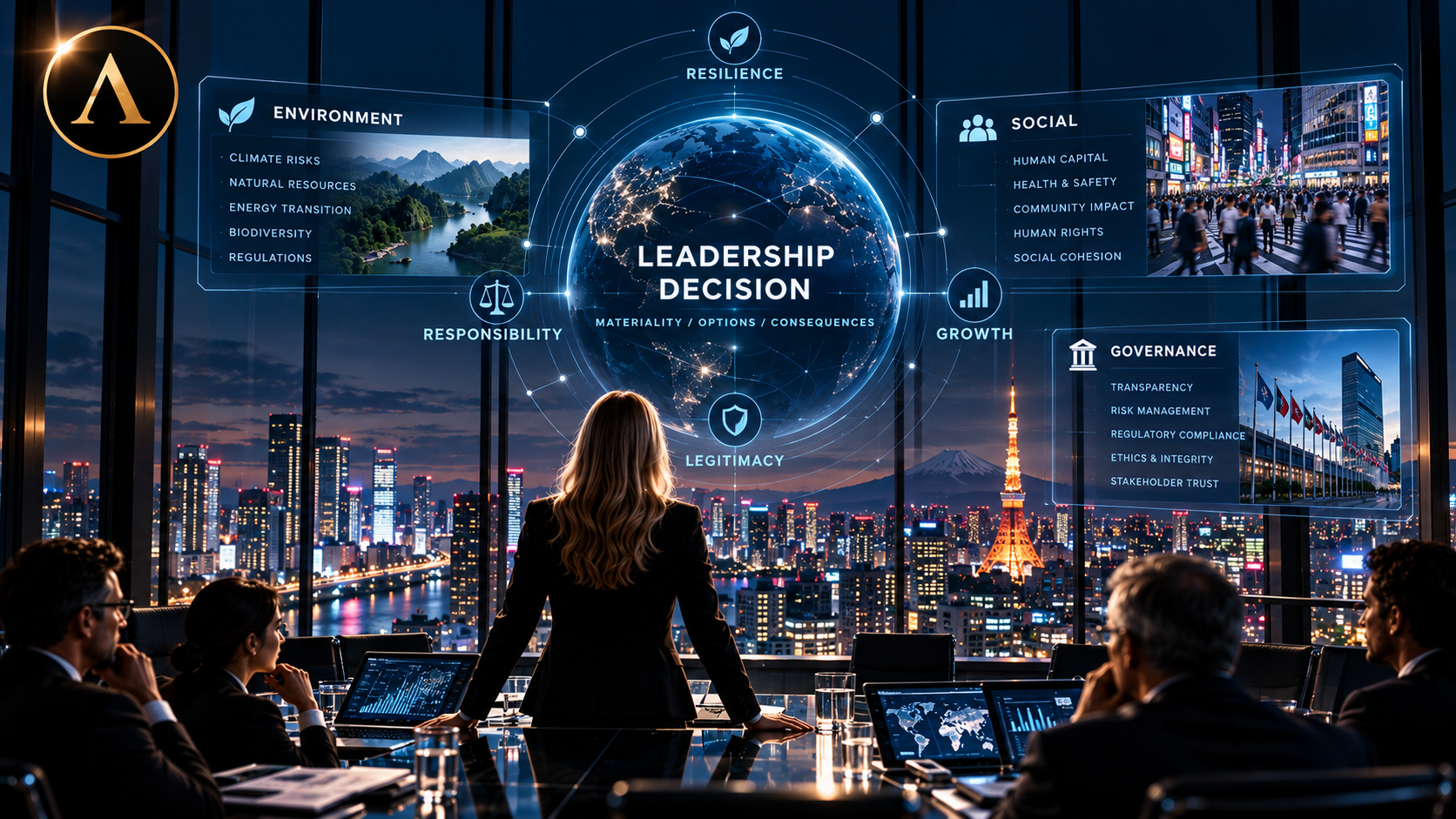
The Institute approaches ESG as part of the environment in which organisations operate and grow. Regulation matters — but so do energy, resources, climate exposure, workforce expectations, governance quality, supply chains, public legitimacy and the ability to adapt before pressure becomes constraint.
Environment, society and governance do not operate in isolation.
Atlas connects the three dimensions to the organisation's wider strategic context rather than treating them as separate reporting categories.
Environment
Climate transition, energy, resources, emissions, physical exposure, biodiversity and environmental regulation can alter costs, assets, supply chains, market access and investment logic.
Social
Talent, workforce expectations, communities, human rights, demographic change, stakeholder trust and social legitimacy increasingly influence continuity, reputation and growth.
Governance
Decision quality, accountability, oversight, incentives, transparency and institutional integrity determine how effectively an organisation responds when strategic pressures collide.
From external pressure to strategic consequence.
The objective is not to collect more ESG information. It is to identify which developments can materially change the organisation's choices.
What is changing?
Identify regulatory, environmental, societal and governance developments.
Where does it touch us?
Connect change to operations, people, markets, assets, supply chains and stakeholders.
What truly matters?
Separate strategic consequence from background noise and reporting volume.
What should change?
Frame options, priorities, trade-offs, timing and governance implications.
What can this strengthen?
Connect responsible action to resilience, legitimacy, innovation and durable growth.
Start with the strategic challenge — not the acronym.
You do not need to decide whether a problem is environmental, social or governance-related before speaking to us. Bring the business question. We identify which pressures, dependencies and responsibilities are strategically relevant.
Sustainability is strongest when it becomes part of how the business competes.
For companies that intend to grow, the strategic question is how environmental, social and governance realities can strengthen rather than constrain resilience, innovation, legitimacy and long-term value creation.
Atlas supports CEOs, management teams and boards in understanding the decisions behind the metrics: what requires attention, what can wait, where exposure is building and where responsible action can create strategic advantage.
From focused strategic question to continuous ESG intelligence.
ESG is part of a wider strategic environment.
Atlas LIVE
Global signals and systemic developments brought together as the operating environment changes.
Enter Atlas LIVE → 02UNDERSTANDIntelligence Core
Seven analytical layers connect planetary, human, civilizational, strategic and geopolitical developments.
Explore Intelligence Core → 03ANTICIPATEStrategic Intelligence
Daily and thematic intelligence identifies trajectories, pressure and what may matter next.
Explore Strategic Intelligence → 04DECIDEAtlas Institute
Strategic context becomes materiality, options, resilience and leadership decision support.
Explore Atlas Institute →The objective is not sustainability as a separate layer around the business. It is a business capable of growing while remaining resilient, legitimate and prepared for the world in which it will have to operate.

Understanding complexity. Supporting decisions. Putting people first.